Guide to Choosing the Right Water Filtration System for Businesses
In business operations, water is not only a basic utility but also a critical factor that directly impacts product quality, operational efficiency and user health. However, each business model has its own specific requirements, making it impossible to apply a one-size-fits-all water filtration solution. That is why a well-structured water treatment consultation from the beginning helps businesses optimize investment costs and ensure long-term system performance.
Why do businesses need consultation before installing a water filtration system?
Many businesses tend to select water filtration systems based on intuition or initial cost considerations. However, without proper consultation, the system may fail to meet actual usage demands. An unsuitable system can lead to:
- Treated water not meeting required standards
- Increased operation and maintenance costs
- Negative impact on equipment and production lines
Therefore, water filtration consultation is not just an optional step, it plays a decisive role in overall investment efficiency.
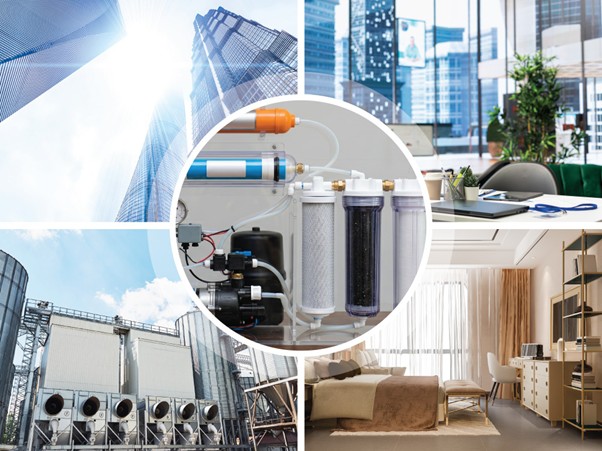
Water treatment solutions play a vital role in modern business operations, from commercial buildings to manufacturing facilities
Key factors to consider when choosing a water filtration solution
To select the right system, businesses need to clearly define several fundamental factors:
1. Input water source
This could be municipal water, groundwater or other location-specific sources. For example, factories and residential areas often rely on groundwater, while office buildings, showrooms, and hospitals primarily use municipal water. Each source has different characteristics and requires appropriate treatment solutions.
Usage purpose
Water demand varies significantly depending on the operational model:
- In manufacturing plants, water may be directly involved in production processes or used for equipment cooling
- In hospitals and schools, water must meet high safety and hygiene standards
- In office buildings, residential complexes, or villas, the focus is typically on domestic use and drinking water
In canteens and F&B services, water must be clean, stable, and safe for food preparation
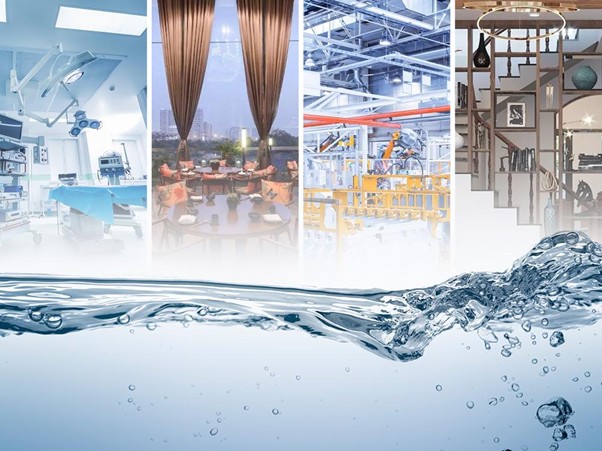
Water filtration consultation should always be tailored to specific industries such as manufacturing, healthcare, commercial buildings or F&B services
2. Scale and capacity
Daily water consumption differs greatly between small showrooms, private villas, large residential complexes and industrial facilities. This directly affects system design and capacity selection, helping avoid underperformance or unnecessary investment.
3. Output water quality requirements
Each industry has its own water quality standards:
- Manufacturing requires stable water quality to protect machinery and ensure product consistency
- Healthcare and education prioritize safety and hygiene
- Residential and commercial buildings focus on clean, odor-free water that is safe for skin and appliances
- F&B and canteen operations require water that meets food safety standards
At this stage, working with a professional industrial water treatment consultant helps businesses clearly define their needs and select the most suitable solution from the start.
Popular water filtration solutions today
Today’s water filtration solutions are designed to meet a wide range of operational needs and scales. At a macro level, many businesses adopt centralized water filtration systems to treat the entire incoming water supply for buildings, residential complexes, or industrial facilities, ensuring consistency across the system.
For direct consumption, point-of-use drinking water systems are commonly installed in offices, canteens, schools, and hospitals to provide safe and convenient water access. Meanwhile, industrial water treatment systems are specifically engineered for production processes, where strict control and consistent water quality are essential.
However, the trend today goes beyond simply “clean water.” It is shifting toward optimizing the overall water experience and operational efficiency. Advanced water technology providers approach water treatment through multiple levels:
- Centralized level: treating water at the source for the entire facility
- Customized level: designing flexible systems tailored to specific models such as showrooms, villas, or service spaces
- Point-of-use level: optimizing water quality directly at the tap to enhance daily user experience
This multi-level approach enables businesses not only to ensure water quality but also to optimize operations, costs, and user satisfaction. There is no “one best system” for all - only the most suitable solution for each specific need.
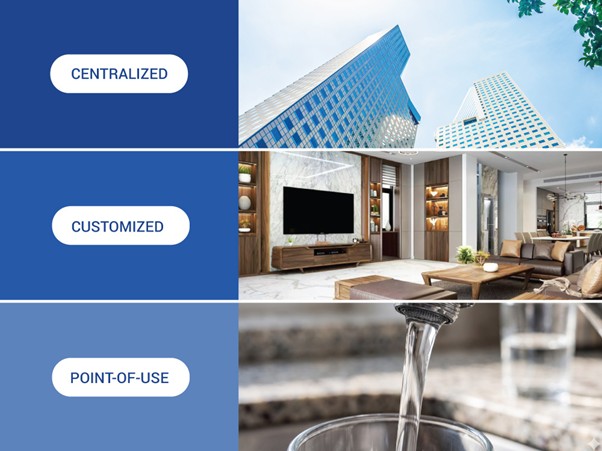
Modern water filtration solutions are deployed across multiple levels, from centralized systems to point-of-use optimization, enhancing both user experience and operational efficiency
Water filtration system consultation and installation process
A professional process typically includes:
- Assessing water usage needs and current conditions
- Analyzing input water quality
- Proposing suitable water treatment solutions
- Designing and installing the filtration system
- Operating, maintaining and optimizing system performance
This ensures the system is correctly designed from the beginning, minimizing risks during operation.
When should businesses invest in a water filtration system?
Businesses should consider investing when:
- The current water source is unstable or shows signs of contamination
- The cost of bottled or outsourced water continues to increase
- Compliance with hygiene and safety standards is required for production or services
In such cases, investing in a proper water filtration system provides a more sustainable and cost-effective long-term solution.
Benefits of choosing the right water filtration solution
With the right consultation from the start, businesses can achieve:
- Optimized investment and operational costs
- Stable and reliable water quality
- Extended lifespan of equipment and systems
- Enhanced operational standards and brand image
This is not just an investment in equipment, but in long-term stability and sustainable growth. There is no universal solution that fits all businesses. The key lies in selecting the right system based on actual needs and operational conditions. Partnering with a professional water treatment consultant ensures accurate decision-making and optimal long-term performance. In this context, advanced water technology brands such as BWT are introducing a more comprehensive approach, going beyond basic water treatment to enhance overall water experience and value. From centralized systems for entire facilities to flexible, point-of-use solutions, water is not only “safe” but optimized to meet modern living and operational standards. This is also the direction many businesses, buildings and residential developments are moving toward when selecting future-ready water solutions.
---------------------------------
Contact information:
Care Viet Nam
Address:
Ho Chi Minh: 7th Floor, Gigamall Shopping Center, 240–242 Pham Van Dong Street, Hiep Binh Ward, Ho Chi Minh City.
Da Nang: 586 Nguyen Huu Tho Street, Cam Le Ward, Da Nang City.
Ha Noi: 3rd Floor, King Palace Building, 108 Nguyen Trai Street, Thanh Xuan Ward, Hanoi City.
Hotline: 0909 411 885 | 0911 401 955 | 0979 045 766
Email: Cs@caresolutions.com.vn
Facebook: https://www.facebook.com/carevietnam.vn
Linkedin: https://www.linkedin.com/company/care-vn/